
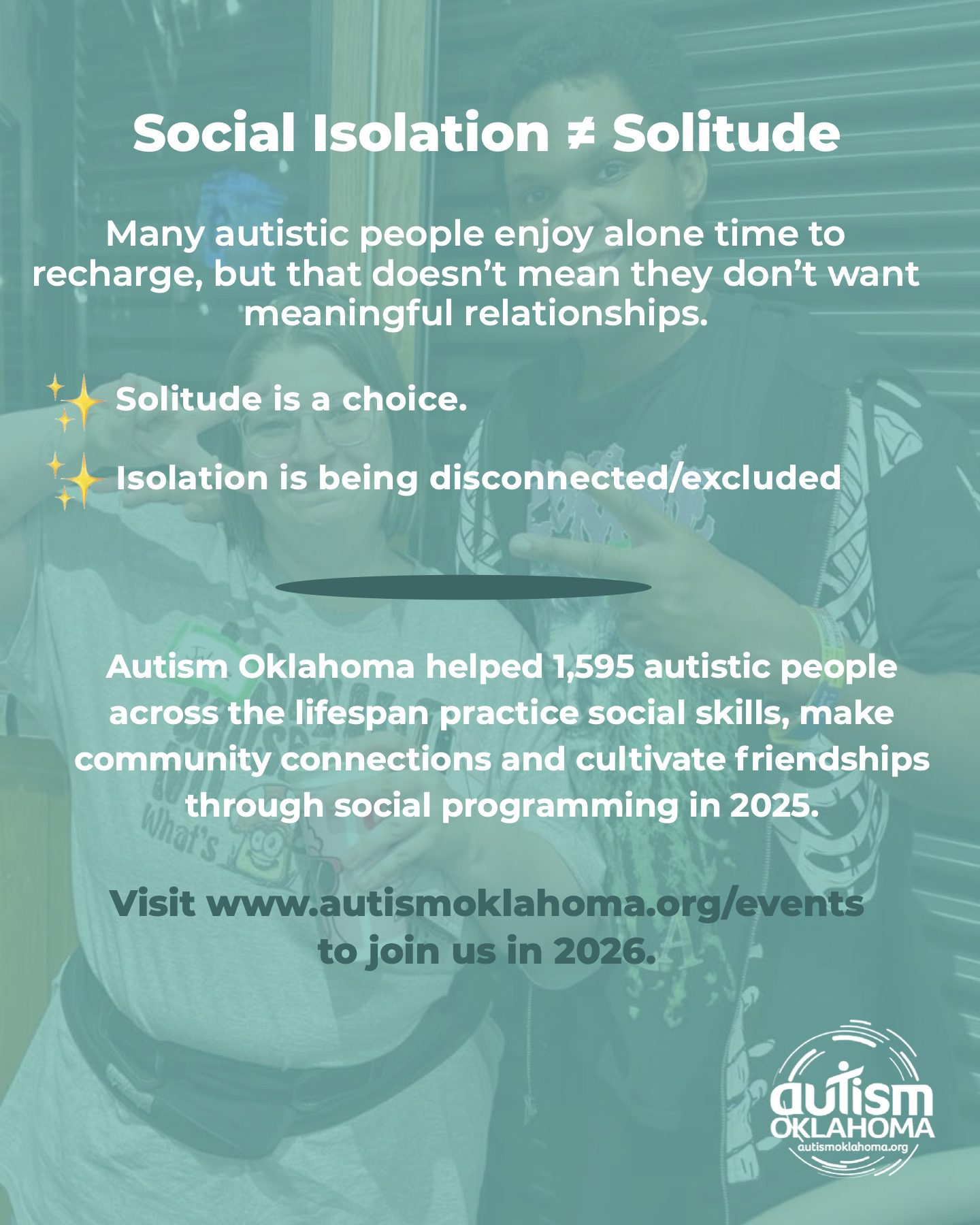
When people think about autism, one of the most common misconceptions is that autistic people simply prefer to be alone. While many autistic individuals do value solitude as a way to rest, regulate or recover from sensory and social demands, that preference should not be confused with social isolation or loneliness.
The difference matters.
Choosing to spend time alone can be healthy and restorative. In contrast, social isolation and unwanted loneliness occur when someone lacks meaningful social connections or feels excluded from relationships and their community. Research consistently shows that autistic people experience higher rates of loneliness than their non-autistic peers, and those experiences can have significant impacts on mental health and overall well-being.
Solitude vs. Social Isolation
Many autistic people intentionally seek solitude after school, work or social activities. Time alone can help reduce sensory overload, manage stress and recharge emotional energy. This alone time is an important part of maintaining well-being.
However, enjoying solitude does not mean someone does not want friendships or meaningful relationships. In fact, many autistic people express a strong desire for genuine connection. The challenge is often not a lack of interest in relationships, but barriers that make building and maintaining those relationships more difficult.
Why Are Autistic People More Likely to Experience Loneliness?
Researchers have identified several factors that contribute to higher rates of loneliness among autistic individuals.
Many autistic children and adolescents experience bullying, peer rejection or exclusion from social activities. These experiences can make it difficult to develop confidence in social situations and can have lasting effects into adulthood.
Communication differences can also create misunderstandings between autistic and non-autistic people. Conversations, social expectations and unwritten rules are often interpreted differently, leading to frustration on both sides. Importantly, this does not mean autistic people lack social interest, rather it means that differences in communication can create barriers to connection.
Another contributor is masking (also called camouflaging). Many autistic individuals consciously or unconsciously suppress autistic traits in order to fit into neurotypical social environments. While masking may sometimes help someone avoid negative reactions, research suggests it often comes at a significant emotional cost. Constantly monitoring one’s behavior can lead to exhaustion, increased anxiety and feelings of loneliness because relationships may feel based on a version of oneself rather than authentic acceptance.
The Mental Health Impact
Research has consistently found that autistic people report significantly higher levels of loneliness–as well as higher levels of suicidal ideation–than non-autistic individuals across childhood, adolescence and adulthood.
More importantly, loneliness itself is strongly associated with increased symptoms of anxiety and depression. While autism is not inherently linked to poor mental health, experiencing chronic social isolation or feeling disconnected from others can contribute to emotional distress.
Many autistic adults describe loneliness not simply as having few friends, but as feeling misunderstood, unseen, or unable to be their authentic selves. This distinction reminds us that meaningful relationships matter far more than the number of people someone knows.
Quality Over Quantity
One of the most encouraging findings from recent research is that social well-being is not determined by the size of someone’s social circle.
A single trusted friend, supportive family member, mentor or community group can provide a powerful sense of belonging. Genuine acceptance often has a greater positive impact than frequent but superficial social interactions.
For many autistic individuals, connection is strongest when shared interests, mutual respect and authentic communication form the foundation of the relationship.
How We Can Help Reduce Social Isolation
Creating opportunities for connection does not mean expecting autistic people to socialize in neurotypical ways. Instead, it means creating environments where autistic individuals can participate as their authentic selves. Families, educators, employers and community members can support belonging by:
- Promoting acceptance rather than expecting autistic people to fit in
- Creating sensory-friendly and predictable environments
- Encouraging participation in interest-based clubs, activities or peer groups
- Recognizing that meaningful friendships often look different for different people
- Respecting an individual’s need for solitude while remaining attentive to signs of unwanted isolation
- Celebrating neurodiversity and cultivating communities where autistic people feel understood and valued
Building Belonging
Perhaps the most important takeaway from current research is this: autistic people are not defined by a lack of desire for connection. Many seek friendships, meaningful relationships and community just as anyone else does.
The goal should not be to increase the number of social interactions or encourage autistic people to mask their differences. Instead, we should strive to create communities where authenticity is welcomed, communication differences are respected and everyone has the opportunity to experience genuine belonging.
At Autism Oklahoma, we know that inclusion goes beyond simply being present. It means being accepted, valued and connected. By understanding the difference between chosen solitude and unwanted isolation, we can help build communities where autistic individuals are supported not only to participate, but to thrive.
As such, AO is proud to have served nearly 1,600 Oklahomans through social programming in 2025. These critical, life-changing experiences not only help folks practice social skills, but facilitate connection, friendships and lasting joy among our participants. Please visit www.autismoklahoma.org/events to join us.
References
Hymas, R., Badcock, J. C., & Milne, E. (2024). Loneliness in Autism and Its Association with Anxiety and Depression: A Systematic Review with Meta-Analyses. Review Journal of Autism and Developmental Disorders.
Umagami, K., Remington, A., Lloyd-Evans, B., Davies, J., & Crane, L. (2022). Loneliness in Autistic Adults: A Systematic Review. Autism.
White, L. L., Tecwyn, E. C., & Petty, S. (2024). Experiences of Loneliness and Connection for Autistic Young People: A Systematic Review. Review Journal of Autism and Developmental Disorders.