
Introversion is not a disorder or disability
Certain autistic traits, such as a preference for solitude, social fatigue or avoidance of large gatherings, can sometimes be mistaken for introversion. Although these behaviors may appear similar from the outside, the reasons behind them are often quite different. Introversion is a personality trait related to how people gain and expend social energy, whereas autism is a neurodevelopmental condition that impacts communication, behavior and sensory processing. Understanding the distinction can help reduce misconceptions and promote greater understanding of both experiences.
Introverts generally feel recharged by spending time alone and often prefer quiet environments, smaller groups or deeper one-on-one conversations. While they often enjoy socializing, too much social interaction can leave them feeling mentally drained. Spending time alone allows them to recover and regain energy.
Importantly, introversion is not a disorder, nor is it a disability. Introverted individuals typically understand social cues, body language and conversational norms. They may opt not to engage in certain social situations because they prefer solitude or find large gatherings exhausting, but they generally have the social skills needed to navigate those situations when they choose to participate.
What is ASD?
Autism, or Autism Spectrum Disorder (ASD), is a neurodevelopmental disability that affects how individuals experience and interact with the world. According to the Centers for Disease Control and Prevention (CDC), autism is characterized by differences in social communication and interaction, as well as restricted or repetitive behaviors, interests or activities.
Autistic individuals may experience challenges interpreting facial expressions, body language, tone of voice or unspoken social expectations. They may also communicate differently than their non-autistic peers. These differences are not signs of disinterest or lack of intelligence; rather, they reflect a different way of processing social information.
The reason behind social withdrawal
One of the most significant differences between introversion and autism is the reason behind social withdrawal. An introverted person may spend time alone because they enjoy it and find it energizing. In contrast, an autistic person may seek solitude for several reasons, including social fatigue, sensory overload, anxiety, difficulty interpreting social situations or a need for routine and predictability. For example, imagine two people leaving a crowded party early. The introverted individual may simply feel socially drained and ready for some quiet time. The autistic individual may also be tired, but the exhaustion is compounded by sensory overload (e.g. loud music, bright lights, multiple conversations happening at once and/or the effort required to navigate complex social interactions). While the behavior looks similar on the surface, the underlying experiences are very different.
Sensory processing differences represent another major distinction. Sensory sensitivities are not a defining feature of introversion, but they are common among autistic individuals. Many autistic people experience heightened or reduced sensitivity to sounds, lights, textures, smells, tastes or touch. Everyday environments that seem manageable to others can sometimes feel overwhelming or even painful.
For instance, fluorescent lighting, background noise, strong fragrances or certain clothing fabrics may cause significant discomfort–even distress–for an autistic person. These sensory experiences can influence social participation and daily activities in ways that are not typically associated with introversion.
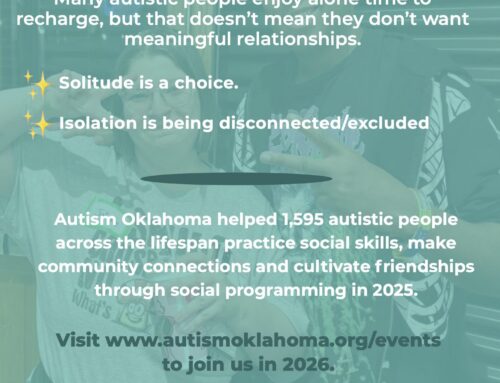
Also noteworthy, autism is not simply a matter of being shy or reserved. Many autistic individuals actively desire friendships, relationships and social connection; but differences in communication styles can sometimes make those relationships more challenging to establish or maintain. In recent years, researchers have increasingly emphasized that communication difficulties often arise from differences between autistic and non-autistic people, rather than deficits within autistic individuals alone.
Key takeaway
The key takeaway is that personality traits and neurodevelopmental conditions are separate aspects of human experience. Not every quiet person is autistic, and not every autistic person is introverted, and by understanding these distinctions, we can move beyond stereotypes and develop a more accurate and compassionate understanding of the folks in our communities.
Autism Oklahoma’s mission centers on creating community connections for individuals and families impacted by autism. If you’re interested in AO programming and events, please visit our website or find us on social media at @autismoklahoma.
References
Centers for Disease Control and Prevention (CDC). “About Autism Spectrum Disorder.” https://www.cdc.gov/autism/about/
American Psychiatric Association. Diagnostic and Statistical Manual of Mental Disorders, Fifth Edition, Text Revision (DSM-5-TR).
Lai, M. C., Lombardo, M. V., & Baron-Cohen, S. (2020). “Autism.” The Lancet, 383(9920), 896–910.
Thye, M. D., et al. (2023). “Sensory Processing Differences in Individuals With Autism Spectrum Disorder.” Frontiers in Integrative Neuroscience.
Milton, D. E. M. (2012). “On the Ontological Status of Autism: The ‘Double Empathy Problem.'” Disability & Society.